Separate the event record from the explanation
A useful incident review distinguishes what happened from what people later believe caused it. Begin with a timeline of observable events: alert fired, customer report arrived, mitigation began, service recovered. Record the source and confidence for each timestamp. Put interpretations in a separate lane or note, so a provisional hypothesis does not become an apparent fact when the diagram is shared. This separation makes it easier for participants to correct the record without arguing over conclusions prematurely.
For a payment-processing disruption, the event record might show a rise in failed requests, an alert threshold, a rollback decision, and a return to baseline. The review can then ask why the signal appeared when it did and how responders chose the rollback. Avoid filling unknown intervals with invented certainty. Mark an interval as “under investigation” or “not captured” and assign someone to establish whether logs or testimony can resolve it.
Use more than one lane
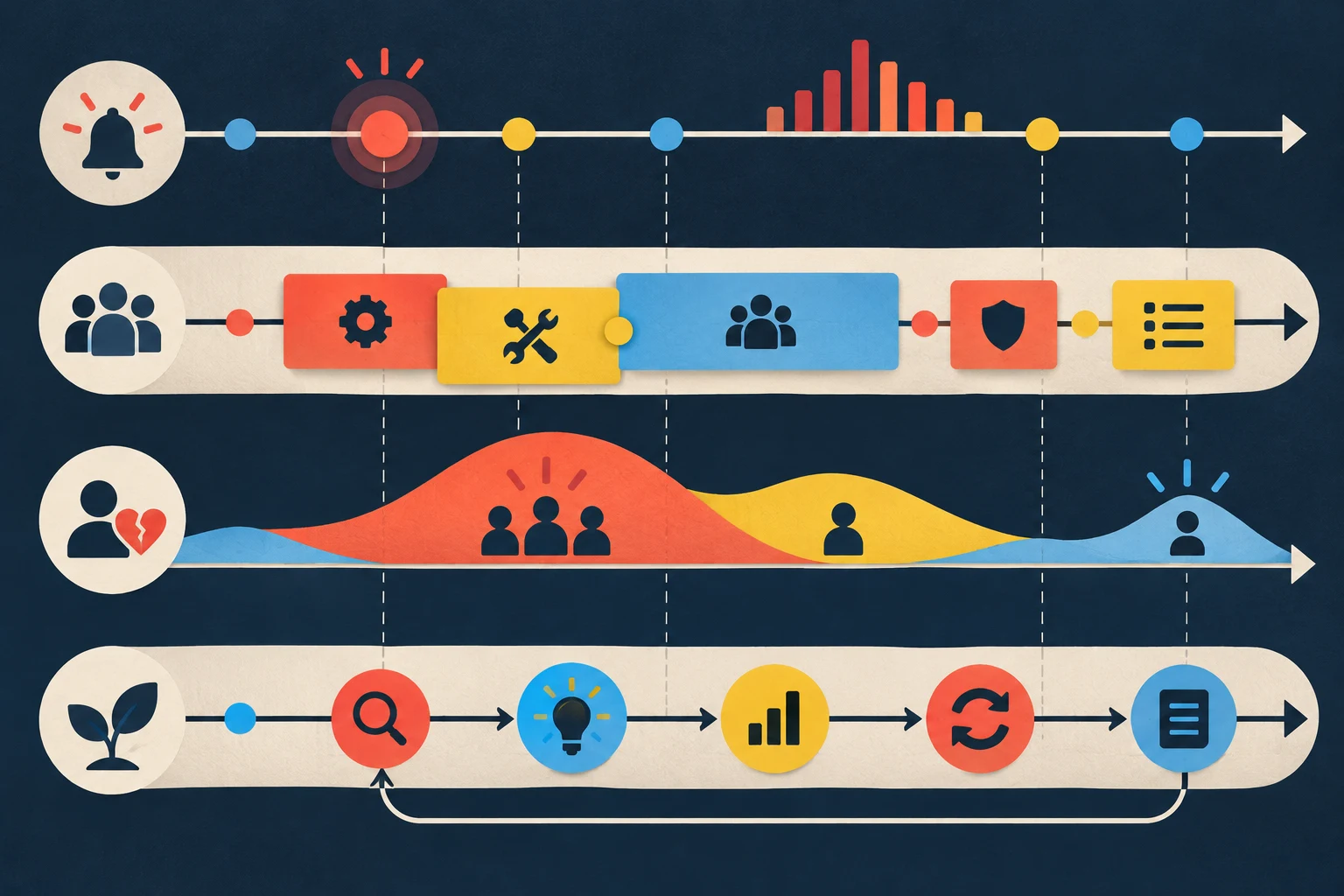
Incidents unfold across systems and people at once. Separate lanes for customer impact, system behavior, detection, response decisions, and communications can reveal timing relationships that a single list hides. Keep lane names concrete and limit the number to what the review needs. If every team receives a lane, the page becomes a roster instead of an explanation. Group related systems or roles where distinctions do not affect the learning question.
In the payment example, an alert may arrive before the support team sees customer reports, while a fallback queue continues processing some requests. Aligning those events helps the group discuss detection and impact together. The picture should not imply causation simply because two marks are adjacent. Label confirmed dependencies and use notes for plausible connections. A reviewer can then see both the sequence and the evidence supporting each relationship.
Show decisions with their available information
A decision should be assessed using the information available at the time, not what became clear afterward. At each major choice, note the signal responders saw, the options they considered, and the constraint that mattered. A rollback might have been chosen because a previous mitigation failed, not because the team ignored a better fix. Recording this context supports candid discussion about whether the process or tooling could make a safer choice easier next time.
Keep the account specific. “Team decided to roll back” hides who had authority and what information reached them. “On-call engineer initiated rollback after error rates stayed elevated for two checks” gives the group something to evaluate. If the threshold was informal, make that visible. The goal is not to grade the responder; it is to ask whether the decision boundary was clear, the evidence accessible, and the available options appropriate under pressure.
Represent impact as a changing condition
Impact often changes during an incident. A map can show which users or workflows were affected at each stage and when a mitigation reduced the effect. Use a concise measure only if the underlying data is reliable and its definition is clear. A count of failed requests, for example, needs a time window and denominator before readers can interpret it. When exact numbers are uncertain, describe the affected workflow and clearly label the estimate or uncertainty.
Do not let a prominent system metric eclipse human consequences. A modest error rate can still block an important customer task, while a noisy alert may affect no user-visible work. Pair technical signals with concrete impact reports and identify where they disagree. This gives leaders a fuller basis for prioritizing follow-up. If the audience needs detailed metrics, attach a sourced analysis; keep the timeline focused on relationships and decisions rather than compressing an entire dashboard into one image.
Turn observations into owned follow-up
The review is unfinished if it ends with a list of lessons and no commitments. Translate each useful finding into an action, an owner, and a way to tell whether the action changed the condition. “Improve monitoring” is too broad to review. “Add a check for queue delay before the customer-facing error threshold” is more concrete, though the team still needs to decide where it belongs and how it will be maintained. Link actions back to the moment on the timeline they address.
Separate immediate repair from prevention and learning. A missing alert may need a near-term fix; a confusing escalation authority may need a policy decision; an unexplained metric may need instrumentation research. Not every observation deserves a project. The review owner should record why an item is deferred or declined so it does not return as a vague recurring concern. Keep the map as an index to the action record rather than as the only place where accountability lives.
Facilitate a fair review
Invite participants who can explain the system, response, and customer experience, and let them review the factual timeline before the meeting. Ask what made sense to them at the time and what would make the next response easier. Avoid questions that imply negligence, such as why someone “failed” to notice an ambiguous signal. A blameless tone does not mean avoiding accountability; it means examining conditions and decisions accurately so the team can improve them.
End by reading back the confirmed chronology, unresolved questions, and follow-up owners. Give people a clear way to correct errors afterward. If the incident contains sensitive security or customer information, use an approved review channel and share a sanitized version for broader learning. An attractive visual does not override access rules. The best review artifact preserves context, uncertainty, and action while protecting people who were affected by the incident.
An Autodiagram timeline can align detection, impact, decisions, and recovery. Enter the confirmed events as text, separate open questions in the outline, and export a PNG to structure the incident review discussion.