Prepare a question and capture surface
A brainstorm becomes hard to revisit when the notes mix suggestions, objections, decisions, and side conversations. Before the library event meeting, write a prompt such as “What would help more neighbors feel welcome at a Saturday library event?” Keep it visible while people contribute. The question gives participants a shared purpose without predetermining the event format.
Prepare a board or page with space for audience, activities, access, location, staffing, and unanswered questions. These are starter areas, not a form that every idea must fit. Let participants add a new branch when it exposes a real dimension. A mind map can flex more easily than minutes, but it still benefits from clear visual zones where related notes can gather.
Collect ideas before evaluating them
Ask participants to write one idea per note for a few minutes. A volunteer may suggest a quiet craft table; a teen may want a local music performance; a parent may ask for stroller access. Capture each idea as stated, then invite people to clarify meaning. Do not decide whether the suggestion is feasible while people are still generating possibilities.
Record constraints alongside ideas without treating them as rejection. “No amplified sound in the reading room” is a venue condition that can shape a music idea; it does not automatically eliminate music elsewhere. Separating possibility from constraint helps the group see whether a workaround exists. If two participants disagree, preserve both views until the relevant question can be checked.
Group by the question each note answers
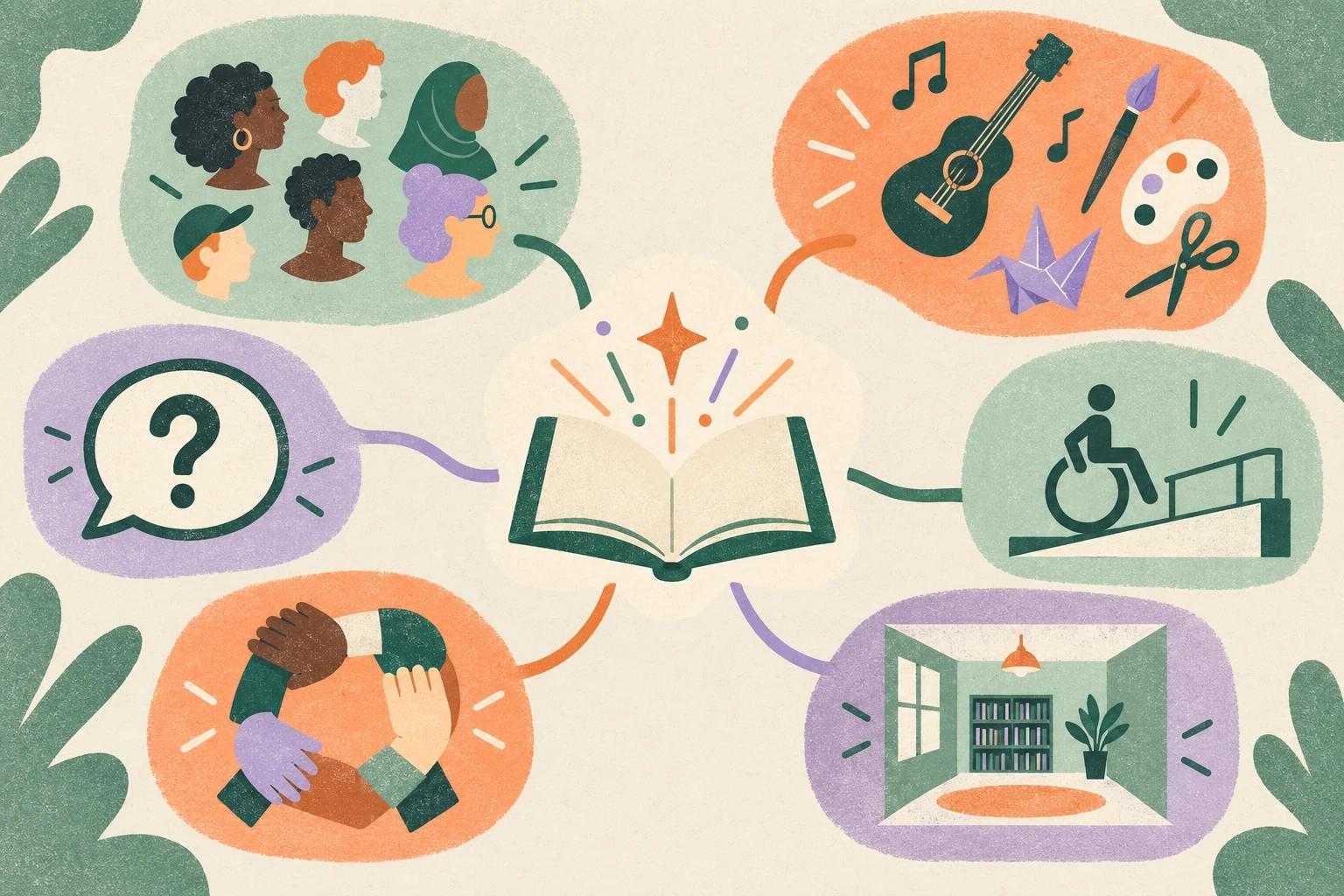
After collecting notes, place activities together, audience needs together, and operational requirements together. A story circle and a music set are activities; a quiet space and step-free entrance address participation; volunteer coverage and cleanup are operational. Name each branch in everyday language so people can add to it later without asking the facilitator.
Some ideas fit more than one branch. A quiet craft table is an activity and an access option for people who prefer low stimulation. Choose a primary home and draw a cross-link only if the dual relationship changes planning. If every note has multiple links, the map becomes cluttered and the team may spend more time debating placement than making the event better.
Mark decisions and open questions differently
A brainstorm does not equal a decision. Use a visible marker for agreed choices, proposals to investigate, and constraints that need confirmation. For example, “reserve community room” may be a decision, “invite local musicians” a proposal, and “can food be served?” an unanswered facilities question. Explain marker meanings in a small legend and label text as well as color.
At the end of the meeting, read the decision and question branches aloud. Ask whether anyone heard a different commitment. Assign a person to investigate each open question and a date for follow-up. If the team postpones a choice, record what information is missing. This prevents the map from becoming a polished snapshot that quietly suggests agreement where none exists.
Run a feasibility pass without losing creativity
Once ideas are grouped, test them against the event’s time, space, access, staffing, and budget constraints. A two-hour event may support a repeated activity rather than several simultaneous performances. The library entrance may be busy, so an information table could need a different placement. These checks refine the brainstorm instead of turning it into a contest for the most impressive idea.
Preserve an idea that the team cannot fit this time in a “later” branch if it still has value. Distinguish “not selected for this event” from “not worth doing.” That nuance can maintain trust among contributors and provide material for a future program. Avoid a catch-all parking lot so large that ideas disappear; name the person who will review it and the next occasion for doing so.
Send a map people can act on
After the meeting, remove duplicate notes but keep useful differences in wording. Add a short caption with the question, meeting date, and status of the map. Share a concise action list with owner and due date, because a branch diagram alone rarely communicates all the coordination details. Invite corrections from participants before treating it as the event plan.
A useful follow-up asks a concrete question: “Did we capture the difference between quiet activities and sensory access needs?” That prompt makes review more productive than asking whether the map “looks right.” If the event changes, revise the relevant branch and mark the new decision. The map becomes a shared planning surface, while minutes or task tracking can hold detailed records and deadlines.
During the library brainstorm, capture agreed branches and open questions as an indented outline in Autodiagram. Choose a mind-map layout to show the clusters, then edit the labels to keep proposals distinct from decisions. Palette controls can support a simple legend, but retain text cues too. Export PNG for participants and SVG for a report that may be resized.