Use one intake language across sources
Product signals arrive through support cases, sales conversations, research, analytics, and internal teams. Each source carries different context and incentives. Agree on a small common record: user or role, task, situation, observed friction, source, urgency, and open question. Do not force every source into the same level of certainty. A sales hypothesis and an observed usability issue should not look identical in the triage queue.
A support case about a missing export, a sales request for scheduled delivery, and a research observation about repeated manual downloads may all relate to reporting. The common record lets the team connect them while preserving their origin. It should link to source systems rather than copy sensitive customer details into a broad board. This gives product operations a way to see patterns without erasing the distinction between direct evidence and internal interpretation.
Separate urgent incidents from roadmap discussion
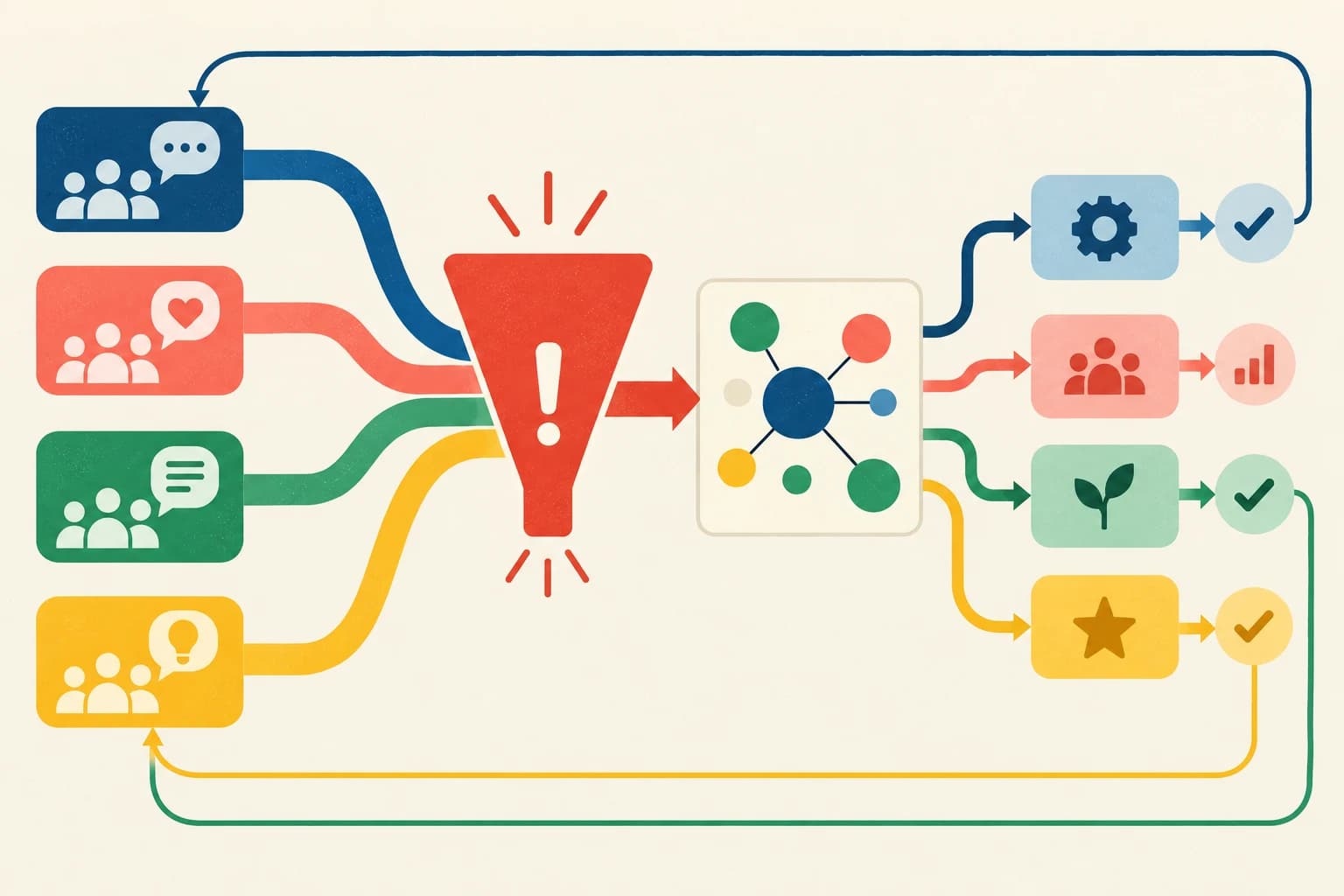
Some feedback requires immediate response: data exposure, widespread service failure, safety concerns, or contractual incidents may follow established escalation procedures. Routine feature feedback should not use that same emergency route. Define observable signals and teach frontline teams where to send uncertain cases. The triage map should make the urgent path prominent and connect it to the responsible incident owner.
If reports show that exports contain another account’s rows, they should not wait for a monthly product review. If several users request a faster export, that may enter ordinary prioritization. The difference is impact and urgency, not how forcefully the request is phrased. Product operations can make this distinction visible while preserving enough context for the incident team. Avoid routing high-impact concerns through a general vote or a popularity count.
Deduplicate carefully and preserve distinct contexts
Triage often merges similar requests to reduce noise. Before merging, compare the user task, trigger, consequence, and proposed outcome. Keep separate records when context could change the solution, and link related items rather than collapsing them. Duplicate counts can indicate interest but should not be treated as a direct measure of customer population or strategic value.
Several teams may ask for scheduled exports, but one wants an overnight file for reconciliation and another needs an immediate report for a customer meeting. The same feature label covers different timing and reliability needs. Product can create one theme with two use cases and investigate the distinct requirements. If the contexts converge on a shared need, then a unified initiative may make sense. This preserves complexity until the team has evidence to simplify it.
Route decisions to the right forum and owner
Different questions need different decision owners. Product strategy may determine priority; security may judge data handling; support may define a safe customer workaround; engineering may validate feasibility. Make the routing criteria visible and avoid asking a large committee to own a choice that belongs to one role. Include a response path when the responsible owner is not yet known.
A request for scheduled exports may need product discovery and a data-retention review before engineering estimates it. Product operations can assign a discovery owner and link a security question to the appropriate reviewer. It should not mark the request “approved” because it received several votes. Record whether the decision is to investigate, build, defer, or decline. That clarity helps customer-facing teams answer questions and prevents the same item from reappearing with a new title.
Communicate status without creating false promises
Internal teams need a consistent status vocabulary that does not imply delivery certainty. Distinguish received, clarifying, under review, committed, in progress, deferred, and declined as appropriate. Explain what each state means and who can change it. External teams should use approved language that describes what is known, particularly when customers ask about timing.
A feedback item can be under review while product compares use cases; that does not mean engineering has scheduled it. Give the account owner a response that acknowledges the need and states the next point at which the team expects to know more, if one exists. Avoid leaving requests in “planned” indefinitely. Product operations should prompt owners to update stale items or explain why the state remains. Honest status protects the relationship and keeps internal forecasts useful.
Use triage patterns to improve upstream work
Repeated incomplete submissions or routing errors may reveal a problem in the intake process, not a lack of discipline. Review where context is lost and improve the source workflow. If a feature request lacks a user task, teach account teams what to ask. If research findings arrive without source links, adjust the synthesis handoff. Product operations can help upstream teams collect better evidence while keeping the request path lightweight.
If triage frequently asks sales who is affected and what the customer tried, add those questions to discovery notes rather than making product operations chase every case. If support requests are missing impact scope, improve case fields or coaching. Measure improvement through fewer clarification loops and better decision readiness, not just more completed form fields. The goal is a usable feedback system that moves important signals toward decisions and returns clear outcomes to the teams who contributed them.
Autodiagram can show how feedback from support, sales, research, and analytics reaches a decision owner and returns to the source team. Export the reusable triage route as SVG.