Turn a topic into a prompt
A mind map begins with a center, but the center should invite useful exploration. “Garden” names a subject; it does not tell a group what to discover. “What would make a shared garden useful through all seasons?” gives neighbors a direction while leaving room for different answers. Write the question in the middle before collecting branches.
The wording also establishes boundaries. A group might discuss growing food, gathering space, maintenance, access, and budget. It probably does not need to map every policy about public land. If the conversation wanders, the central question gives the facilitator a gentle way to ask whether a new idea helps answer it or belongs in a separate discussion.
Invite different kinds of contribution
Give people a quiet moment to write ideas before anyone starts drawing branches. A gardener may mention soil and sunlight; a parent may want a safe place for children; a nearby resident may worry about noise or unattended tools. Private notes reduce the chance that the first confident voice defines the whole map.
When the group shares, record ideas in their language before grouping them. “Somewhere to sit after work” may later fit under community space, but rewriting it immediately as “amenity” can lose the reason it matters. Keep an unresolved phrase visible until participants agree on a concise label. The map should help people recognize their contributions, not translate them into committee jargon.
Create branches that answer the prompt
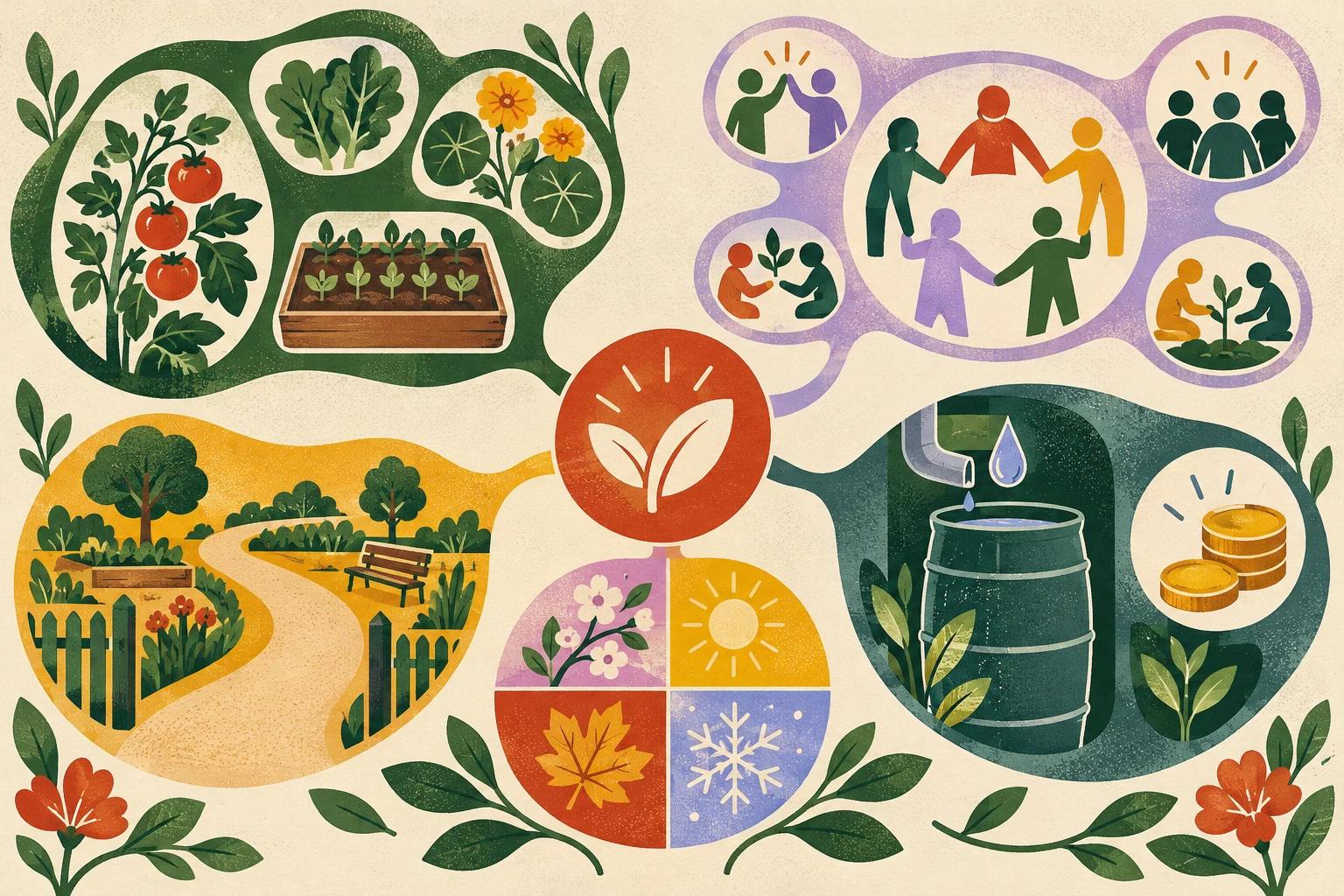
For this garden, first-level branches could be “food and plants,” “people and access,” “space and facilities,” “care through the year,” and “resources.” These categories separate different kinds of questions. Place “raised beds” under growing needs, “wide paths” under access, and “watering rota” under ongoing care. Do not make every suggestion a top-level branch.
Ask whether two branches are actually parts of the same concern. “Watering” and “summer care” may overlap, while “access” has a distinct audience and set of decisions. Grouping is a judgment, so let the group see the proposed parent-child relationship and challenge it. A mind map is not a neutral dump: its structure communicates which ideas belong together.
Use a concrete pass to find gaps
Walk through one plausible year. In spring, residents prepare beds and decide what to plant. In summer, someone waters during dry weeks and the group handles produce sharing. Autumn brings cleanup and seed saving; winter raises questions about storage, meetings, and who checks the site. This pass exposes missing seasonal work that a wish list may conceal.
Now walk through the first month of operation rather than the idealized full year. Who unlocks the gate? Where does a new volunteer find tools? What happens if the assigned gardener is sick? Convert answers into sub-branches or open questions. The point is not to solve the entire project in the map, but to reveal practical dependencies before the group commits to a design.
Keep the map open without making it endless
Mind maps encourage exploration, yet every additional layer costs legibility. Stop subdividing when another child would not change a decision or help someone act. “Watering” may need a branch for supply, schedule, and backup owner; “color of the watering can” likely belongs in a later shopping list, not the planning map.
Use a marker for ideas that need follow-up: confirmed need, unresolved question, or possible experiment. Explain the marker in a small legend. Do not rely on color alone, and do not turn a brainstorm into a false consensus by styling all ideas identically. The map should distinguish proposals from agreed commitments when people will later use it to plan work.
Turn the exploration into a next step
Close by selecting one action under each priority branch. The group might test a weekend volunteer rota, ask the land manager about water access, and invite neighbors to review the path width. Record an owner and a date outside the map or in a clearly marked action list. Without that transition, the map can preserve good ideas while leaving the project motionless.
After the meeting, share the map with a brief note explaining which ideas were accepted, which remain open, and how people can correct a misgrouped contribution. In Autodiagram, indented lines can represent nested ideas; begin with a compact text outline and adjust the arrangement once branches are clear. A readable map gives the group a common surface for continued thinking, not a claim that planning is finished.
Put the garden question in Autodiagram’s title field, then add branches for plants, access, space, seasonal care, and resources as indented lines. Choose a mind-map layout and adjust the branch labels after the group agrees on categories. The palette and font options help the shared map read on a meeting screen; export PNG or SVG for follow-up.