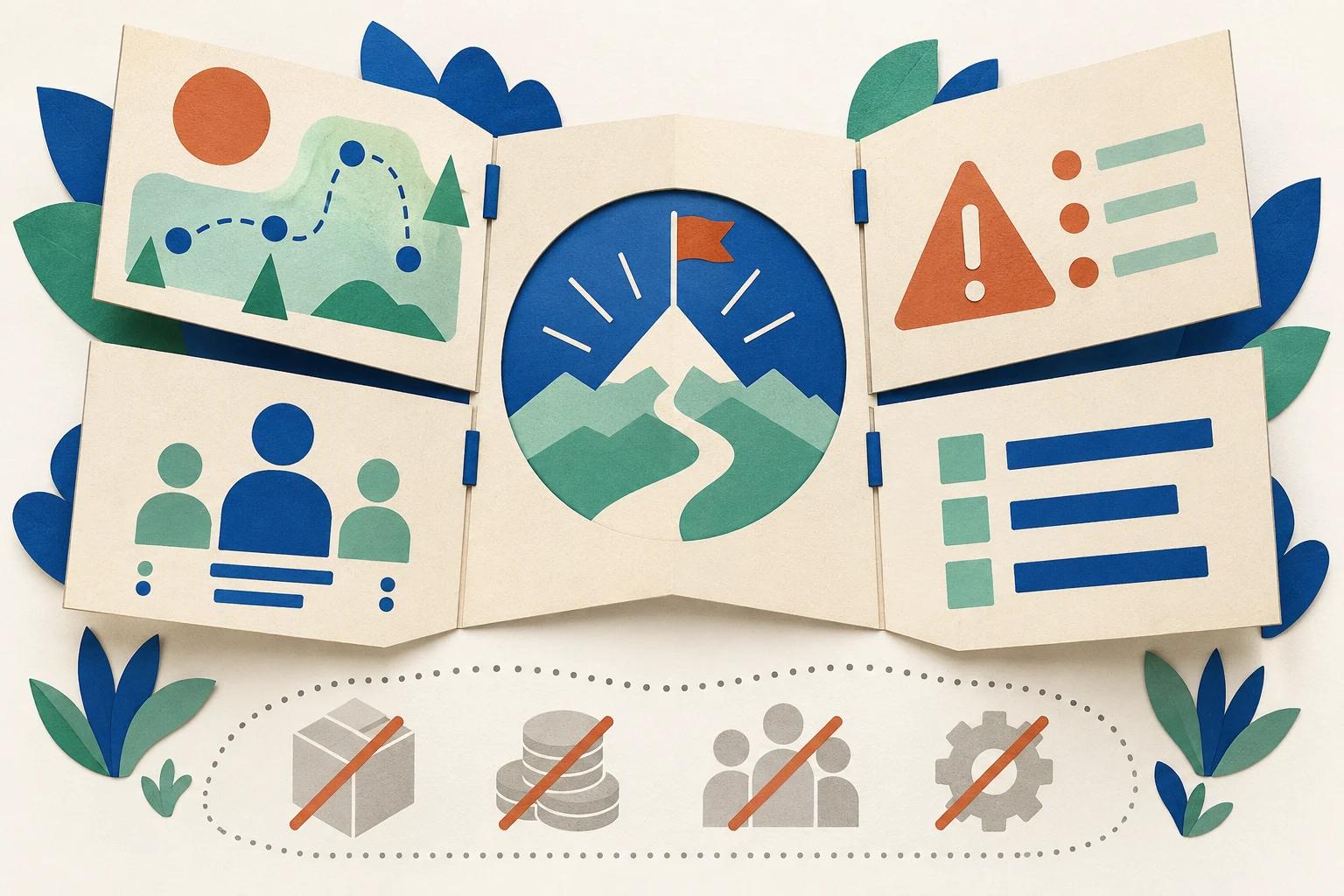
Name the roles that shape decisions
Teams often confuse participation with authority. List who contributes expertise, who approves scope, who owns delivery, and who must be consulted because the work affects them. One person can fill several roles, but the decision right should remain clear. For each major choice, identify the owner and the evidence or input they need. This reduces repeated discussion and lets contributors know when their responsibility ends.
In the search project, librarians may define policy language, security may review access boundaries, engineers may own index behavior, and the sponsor may choose which repositories enter the first release. Write these relationships in plain terms. If one role is missing, identify how the team will obtain that input. A project map should not imply that a group vote can replace a policy owner or that a sponsor can settle a technical fact by preference. It helps decisions reach the appropriate person with relevant context.
Surface constraints before they become surprises
Ask what calendars, tools, approvals, data, or other teams constrain the work. A constraint differs from a preference: it changes what routes are feasible. Show the earliest point where each constraint matters and who can confirm it. If an assumption has not been checked, mark it. This gives the team an early chance to explore a different path rather than reporting a preventable delay after the dependency becomes urgent.
The search team may need access to records with different retention rules or may be unable to index restricted repositories. Those boundaries can shape architecture and pilot selection. Ask the policy owner to confirm the conditions before promising broad coverage. Meanwhile, engineering can prototype against approved sample content. The kickoff map makes the parallel route visible and prevents “we are waiting for security” from becoming a vague blocker. It also avoids treating a compliance constraint as a late-stage checklist item.
Agree on how the team will work together
Working agreements should solve actual coordination needs. Decide where status lives, how people raise blockers, what deserves a meeting, and how quickly a decision must be escalated. Avoid imposing a long list of generic rules that no one remembers. Include time-zone expectations, accessibility needs, and ways to contribute asynchronously when relevant. A working agreement is a tool to reduce friction, not a judgment about individual commitment.
A distributed team might agree to keep decisions in a project record, use chat for time-sensitive coordination, and reserve a weekly overlap meeting for cross-team dependencies. Someone who finds an issue can flag it with impact, owner, and a proposed next step. The team should choose response windows it can honor. If an urgent incident needs a separate on-call route, link to that route rather than expecting people to monitor every channel continuously.
Build the first work sequence together
Map a short initial horizon rather than pretending to predict every task until launch. Identify discovery, decision, and delivery steps that are understood, plus dependencies that could change the route. Ask owners to confirm capacity and deliverables. This conversation can expose tasks that are too broad or work with no accountable owner. Leave room for learning; a project plan that cannot accommodate discovery will turn new evidence into a schedule failure.
The search team might begin by sampling approved documents, documenting current retrieval gaps, and testing two indexing approaches. A decision gate then chooses which repositories to include in a prototype. The map shows what can start now and what requires that decision. It does not claim a final launch date until feasibility and policy constraints are better understood. Sponsors can see why early work is valuable even before the team can give a confident end-to-end forecast.


