Reconstruct the work before judging it
Retrospectives can become rounds of opinions about whether a project went well. Begin with a shared account of the work: what the team expected, what happened, where decisions changed, and what participants observed. A timeline or set of work stages can help people anchor comments in events. Keep facts distinct from interpretations and let teammates correct the record without having to defend their character.
A product team may remember that a feature review happened late, but the sequence can show why: an interface decision waited on a customer terminology review, while engineering had already built against an earlier label. This is more useful than “communication was bad.” Ask what each group knew at the time and which dependency was visible. The aim is a fair picture of conditions and choices, not a search for one person to blame for an outcome shaped by the system.
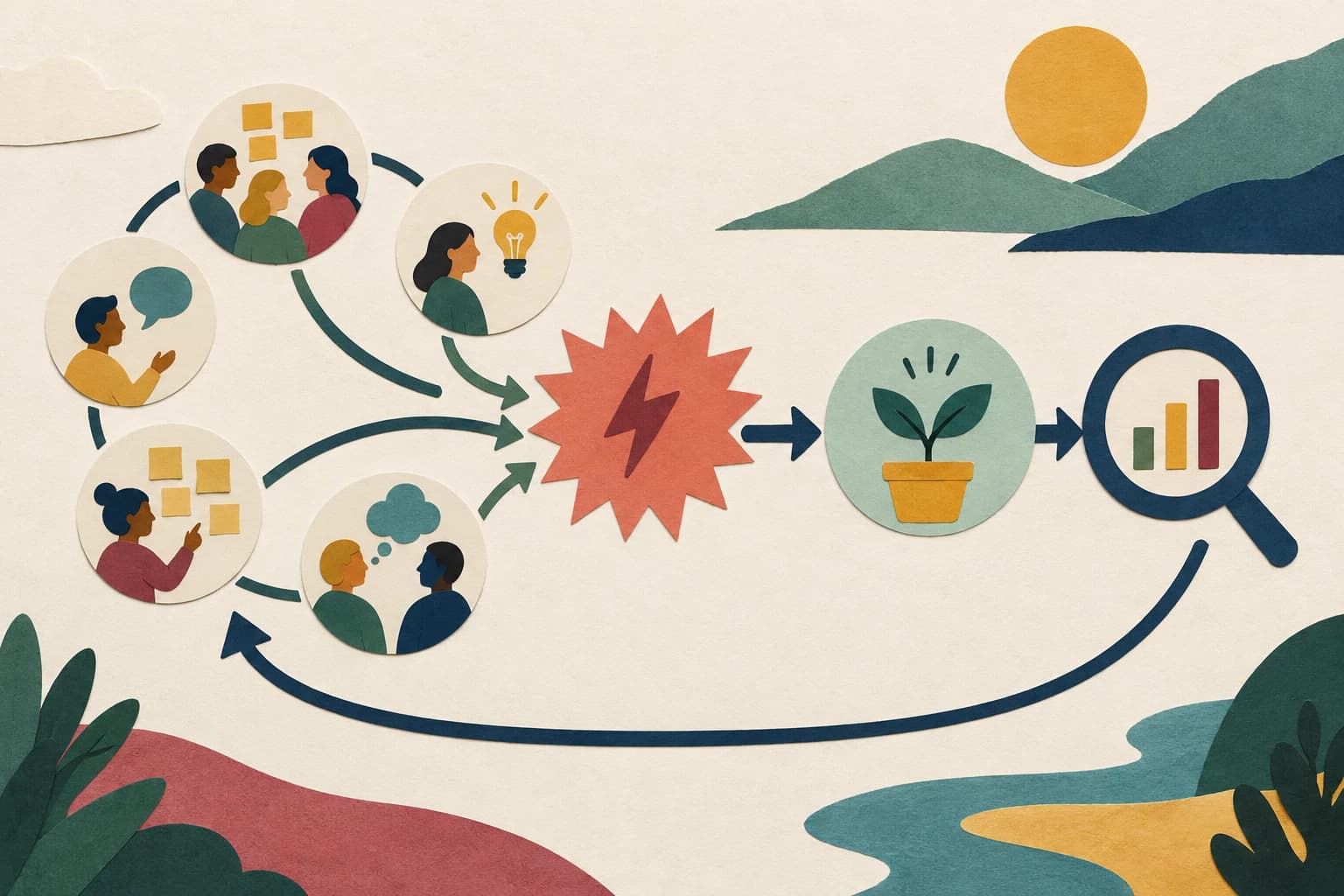
Gather observations from more than the loudest voice
Not everyone reflects aloud in a group at the same pace. Collect observations silently first, or invite written input before the session. Ask about specific moments: what helped, what slowed work, what surprised the team, and where quality was at risk. Give people permission to pass on a topic. If the retrospective includes sensitive experiences, use the organization’s appropriate support route rather than pressuring participants to disclose in front of colleagues.
In the late-review example, an engineer may have noticed an ambiguous label weeks earlier but assumed product had approved it. A researcher may have believed the terminology decision was already settled. Capturing both accounts reveals a handoff gap. It may also expose unequal information access. Make sure the facilitator does not turn a pattern into a complaint about a particular role. Ask what condition made the assumption reasonable and how the team could make the next decision visible.
Find a changeable condition, not a slogan
When a problem recurs, ask what part of the work system can be changed. “Communicate better” provides no lever. “Record the decision owner and status on the project brief when a terminology review starts” suggests a concrete adjustment. Choose a condition the team can influence. Some causes, such as an external approval queue, may need escalation rather than a local habit. Make that distinction explicit so the team does not accept responsibility for constraints it cannot control.
For the interface review, the group could add a small decision log field for label, owner, reviewer, and status. The point is not to create a new document for every conversation; it is to keep a consequential decision findable. Before choosing this change, check whether the existing project record already supports it. A retrospective can itself create process clutter if each issue generates an unrelated checklist. Prefer changing one step in the current workflow when that is enough.
Design an experiment that can teach the team
A retrospective action is stronger when framed as an experiment. State what will change, who will try it, on which work, and what observation would indicate it helped. Keep the test small enough to reverse. If the team expects a policy change, involve the relevant owner rather than experimenting outside its authority. Agree on when to review the result; otherwise the experiment becomes a permanent process by default.
For the next two interface decisions, the product designer could add a status field to the existing brief and ask reviewers to confirm it before implementation starts. The team can compare whether late label changes still occur and ask participants whether ownership was clearer. Two cases will not prove a universal effect, but they can reveal usability issues with the new practice. The experiment should have a stop condition if it adds overhead without improving visibility.
Assign follow-up without assigning blame
One person should own the experiment’s next check, but that does not mean they are responsible for every cause discussed. Name the owner as a coordinator: they will gather observations, remind the team of the review date, and bring a recommendation. If the experiment affects another team, secure agreement from that team. Record dependencies and any support needed from leadership. Accountability works best when the owner has enough authority and time to complete the follow-up.
The designer may coordinate the review, while the product lead approves changes to the brief and engineering reports whether implementation began against stale labels. If the practice shows promise, the team can decide to adopt it, revise it, or stop. Put that decision on the calendar or in the existing project rhythm. A retrospective board with many unowned action cards creates the appearance of learning while leaving the same conditions untouched.
Close the loop in the next retrospective
Start the next reflection by revisiting the prior experiment. Report what happened, what the team learned, and what it decided. If the action was not completed, ask whether its owner lacked capacity, the proposed change was unclear, or the team no longer believed it mattered. Do not silently carry it forward. A team earns trust in retrospectives by showing that observations can result in thoughtful changes, including a deliberate choice not to act.
If decision visibility improved but meetings became longer, the team might keep the status field and remove a redundant review. That mixed result is valuable. Update the working agreement and explain the reason. Over time, a small set of checked experiments is more credible than a large collection of inspirational lessons. The retrospective’s purpose is not to eliminate friction; it is to make the team better able to notice, understand, and respond to the friction that matters.
Use Autodiagram to trace a retrospective observation into a small experiment, owner, and learning check. Keep personal details out of broad views and export a PNG for the follow-up.