Replace the hunt for a universal winner
Comparisons often promise a winner when the real decision depends on context. A live meeting can resolve ambiguity quickly, while an async memo gives people time to consider evidence and respond across time zones. Each format creates value and cost. A useful comparison states those tradeoffs and identifies which ones matter for this decision.
Begin with a specific scenario: a distributed team must review a proposal with several unresolved questions before a release decision. Name the audience, deadline, and decision authority. The same comparison may lead to a different choice for a routine status update or a sensitive personnel discussion. Context keeps recommendations from turning into generic advice.
Choose dimensions that reveal consequences
Compare preparation effort, speed of clarification, ability to inspect detail, participation across time zones, and durability of the decision record. Each dimension should describe a consequence, not a feature label. “Interactive” matters only if people need to challenge assumptions in real time; “asynchronous” matters if participants cannot attend together.
Keep dimensions independent where possible. “Convenience” may bundle scheduling, time zones, and preparation, making the comparison hard to interpret. Break it into meaningful parts or choose the one that affects the decision most. A short matrix with five well-chosen dimensions is often more useful than a comprehensive grid whose rows overlap.
Describe both benefit and cost
For the live format, a benefit is rapid clarification; a cost is that quieter participants may need more time to formulate a response. For an async memo, a benefit is deliberate review; a cost is slower convergence when people respond at different times. Avoid assigning every advantage to your preferred option and every burden to its alternative.
Use parallel phrasing and similar detail. If one cell contains a carefully qualified paragraph while the other says “slower,” readers may perceive a bias even when none was intended. Add the condition that changes the assessment: a short live session works when questions are focused and pre-reading is available. Nuance makes the comparison more actionable, not less decisive.
Walk through the team’s proposal
The team needs to approve a new triage taxonomy. Several edge cases could change whether an issue is labeled urgent, and the decision owner wants input from support and engineering. A short live workshop after circulation of a written draft may fit: the memo supplies detail, while discussion resolves ambiguous cases. The comparison has produced a combination rather than a single-format verdict.
Now compare that with a monthly status report that contains no decision. A written update may be sufficient, and a live meeting would consume attention without enabling useful clarification. This contrast shows why the comparison must be applied to a concrete task. Record what would change the choice, such as a new unresolved question or a participant who cannot access the live session.
Make the recommendation conditional
A recommendation can be clear and still state its assumptions: “Use a memo followed by a bounded discussion because the taxonomy has unresolved edge cases and a named decision owner.” Mention what would change the recommendation, such as a policy deadline that prevents discussion. Conditional language helps readers adapt the reasoning when circumstances differ.
If one factor is non-negotiable, mark it separately from preferences. An accessibility need may require a transcript or alternate contribution route regardless of the selected format. A matrix should not suggest that every need can be traded away for speed. Identify constraints first, then compare viable options within them.
Review how the decision worked
After the review, check whether the selected format achieved its purpose. Did the live discussion resolve edge cases? Were async comments included in the decision? Did the written record explain why a label was chosen? Those observations can refine future comparisons and reveal a step that should be standard practice.
Keep the matrix small and tied to its scenario. Do not turn one team’s experience into a permanent rule for every decision. Store the reasoning with the proposal and revisit it when the audience, evidence complexity, or urgency changes. A comparison is most useful when it helps people discuss consequences openly, then choose with awareness of what each option costs.
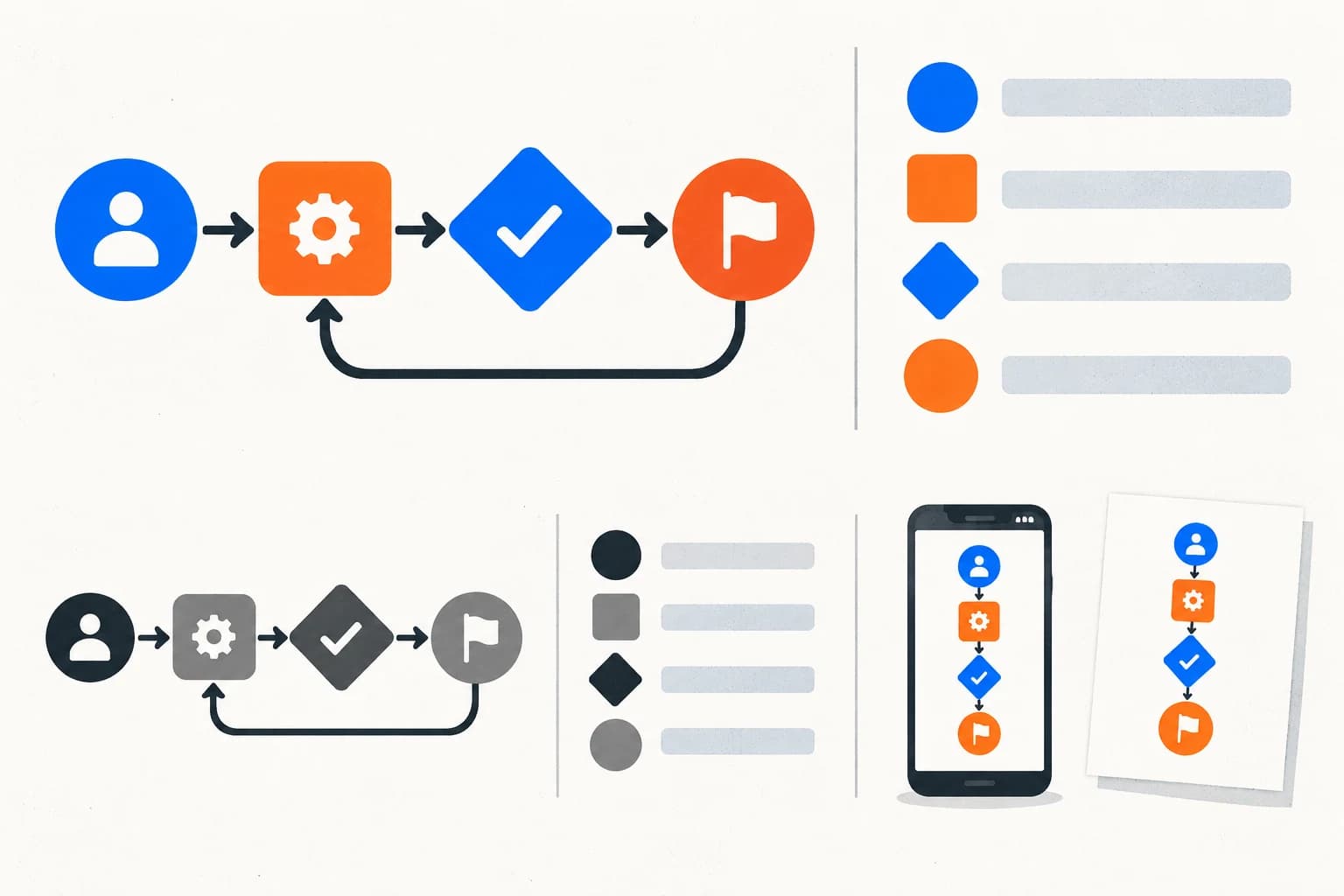
Use Autodiagram to outline the live, memo, and hybrid review choices, then select a comparison layout that leaves room for both benefit and cost. Edit the scenario and assumptions into the labels so the recommendation is conditional. Palette controls can help group dimensions; export PNG for a meeting or SVG for a decision record.