Name the choice before ranking preferences
A decision tree for choosing a meeting format should answer a concrete planning question: how should this team review a particular decision? It should not declare one format universally best. A live call can resolve ambiguity quickly; a written memo can give people time to inspect evidence; a recording can orient people who cannot attend at the same time.
List the real options and the conditions that make each useful. Include the team’s capacity to prepare materials and the audience’s need to ask questions. If the group has a strong preference for calls, treat that as a preference to discuss rather than hiding it inside a supposedly objective decision rule.
Use questions that separate the formats
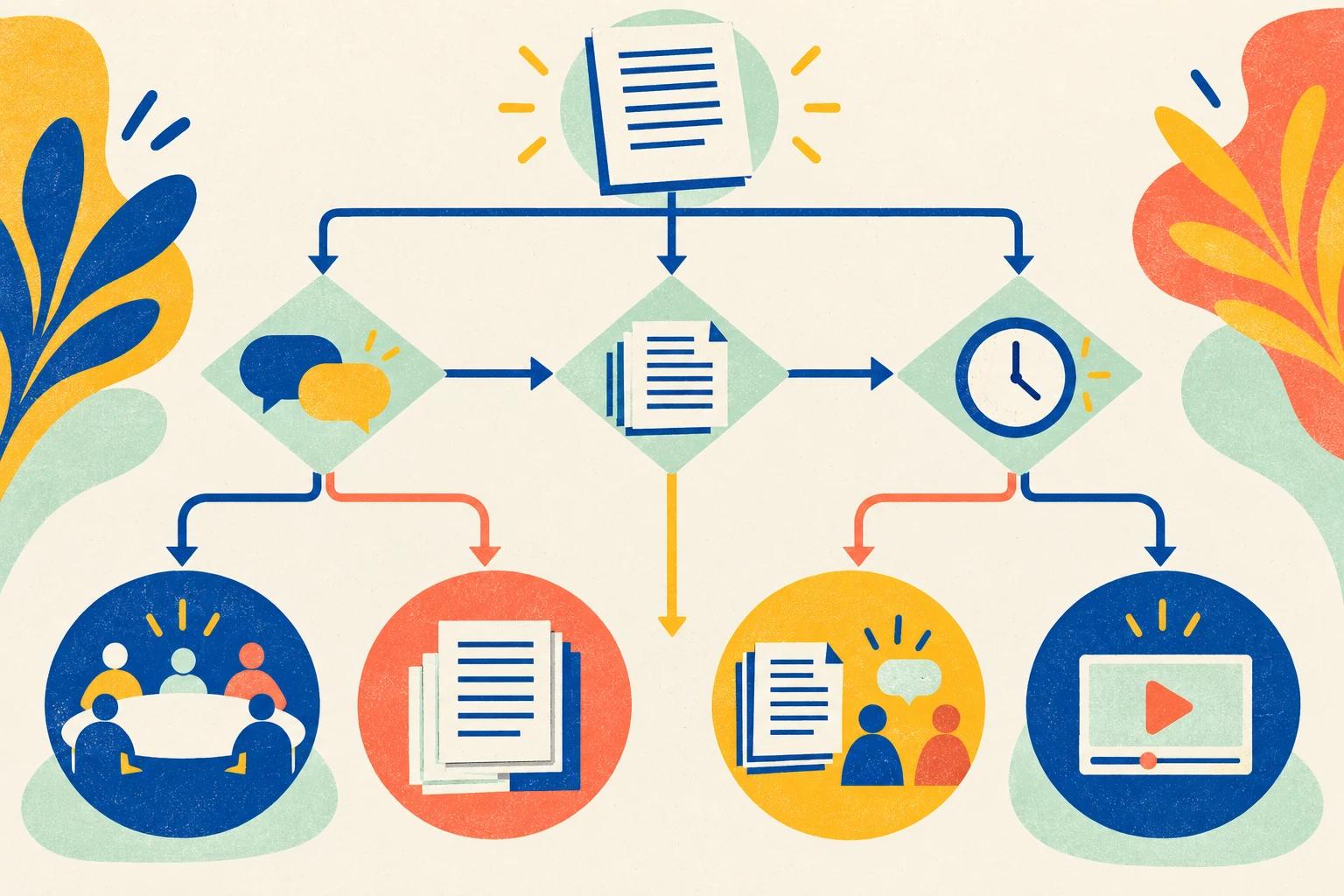
Begin with: does the decision require immediate back-and-forth to resolve open questions? If yes, a live session may be useful. If not, ask whether participants need to inspect detailed evidence at their own pace. A written memo can serve that need. A short recorded walkthrough may help when the decision is simple but the context is unfamiliar.
Avoid asking “Is this important?” Nearly every decision matters to someone, and the answer does not distinguish formats. Ask about observable needs: number of unresolved questions, complexity of evidence, time zone constraints, and whether a decision owner must hear objections before deciding. Each question should narrow options or change the preparation required.
Walk through a real review
Suppose a team must decide whether to change its bug triage labels. The proposal includes examples of current misclassification and a draft label set. Several people have edge cases to challenge, so the first question—whether discussion is needed to resolve the proposal—may route to a live working session. The decision owner can invite specific roles and circulate the draft in advance.
Now consider a routine monthly status update with no decision required. A concise written update may be enough; a recording would add effort without improving understanding. For a complex analysis where reviewers need time to inspect charts, send a memo before a short discussion. The tree can end in a hybrid route when formats solve different parts of the task rather than forcing a single winner.
Account for accessibility and participation
A live meeting can help people ask questions, but it may disadvantage colleagues across time zones or people who need more time to process information. A written route supports reflection, yet long dense memos can be difficult to navigate. A recording can be paused and replayed, but it needs captions or a transcript to work for more audiences.
Do not make accessibility a last-minute exception. Include it among the planning questions and provide an alternate way to contribute. If the team chooses a live meeting, share the decision materials beforehand and publish the outcome afterward. If it chooses async review, name the response deadline and how the decision owner will handle conflicting feedback.
Keep the tree advisory, not automatic
The format decision depends on context. A small change can still need live discussion if it alters responsibilities; a major analysis may be well served by a written review when the evidence is clear. Phrase leaf nodes as recommendations and conditions: “Use a short live session when unresolved questions affect the decision.” Avoid implying that the tree can replace the owner’s judgment.
If options have similar benefits, make the tradeoff visible. A hybrid process—memo, bounded discussion, written decision record—can work, but it has preparation costs. Do not default to every format for every topic. Pick the smallest combination that meets the audience’s needs and leaves a durable account of the decision.
Learn from the format after the decision
After the review, ask whether the chosen format let participants understand the evidence and contribute. Did the live session resolve uncertainty or merely repeat the memo? Did async reviewers have enough time? Did the recording need a clearer transcript? Use concrete observations to revise the questions and examples in the tree.
A format guide is most helpful when it stays lightweight. Keep the main decision path to a few meaningful questions, then link to detailed practices for meeting facilitation, memo writing, or recording access. Revisit it when team composition or collaboration needs change. The goal is a deliberate choice that fits this decision, not compliance with a diagram for its own sake.
Draft the live, memo, and recorded review choices in Autodiagram as questions with indented recommendations beneath them. Choose a process layout, then edit the branch text to reflect the team’s actual deadline and accessibility needs. Palette and font controls can distinguish the three routes; export the result as SVG for a decision memo or PNG for a planning slide.