Decide whether the meeting is the right tool
Before drawing an agenda, name the work that requires people together. A meeting can help when participants need to compare interpretations, negotiate a tradeoff, or make a decision that depends on their combined knowledge. It is a poor default for a status update that could be read asynchronously. Define the output in a sentence: “Choose the first customer group for the pilot” is clearer than “align on rollout.” The output determines who needs to attend and what preparation matters.
Suppose a team has three pilot candidates: internal staff, a small set of existing customers, or one new customer segment. The meeting exists to select a path, not to read every research note aloud. Send the evidence and options before the session, then reserve time to challenge assumptions. If no one in the room has authority to decide, identify that before inviting ten people into a conversation that can only create recommendations.
Build an agenda around the decision path
Arrange the conversation so participants move from shared context to options, tradeoffs, and a choice. Put the purpose, decision owner, and any constraints at the top. Allocate time to the discussion that can change the answer, not to every agenda item equally. Include a short opening to confirm the question and a close to state the decision and actions. When topics are independent, separate them; a disagreement about one choice should not consume time reserved for another.
For the pilot decision, the agenda might first confirm the research signal and support capacity, then compare the three candidates against learning value, reversibility, and service burden. Ask what evidence would change each person’s preference. Reserve the last minutes for the owner to choose or name what additional information is needed. The structure prevents a common failure: a lively discussion that ends with everyone believing a different decision was made.
Make participation work for the people in the room
Invite people because they bring knowledge, a necessary perspective, or decision authority. Tell them why they are included and what preparation is expected. Some participants think better after reading or writing, so allow a moment for silent reflection before open discussion. This reduces the chance that the quickest speaker defines the options before others have formed a view. Provide an accessible way to contribute for people joining remotely or unable to speak at length.
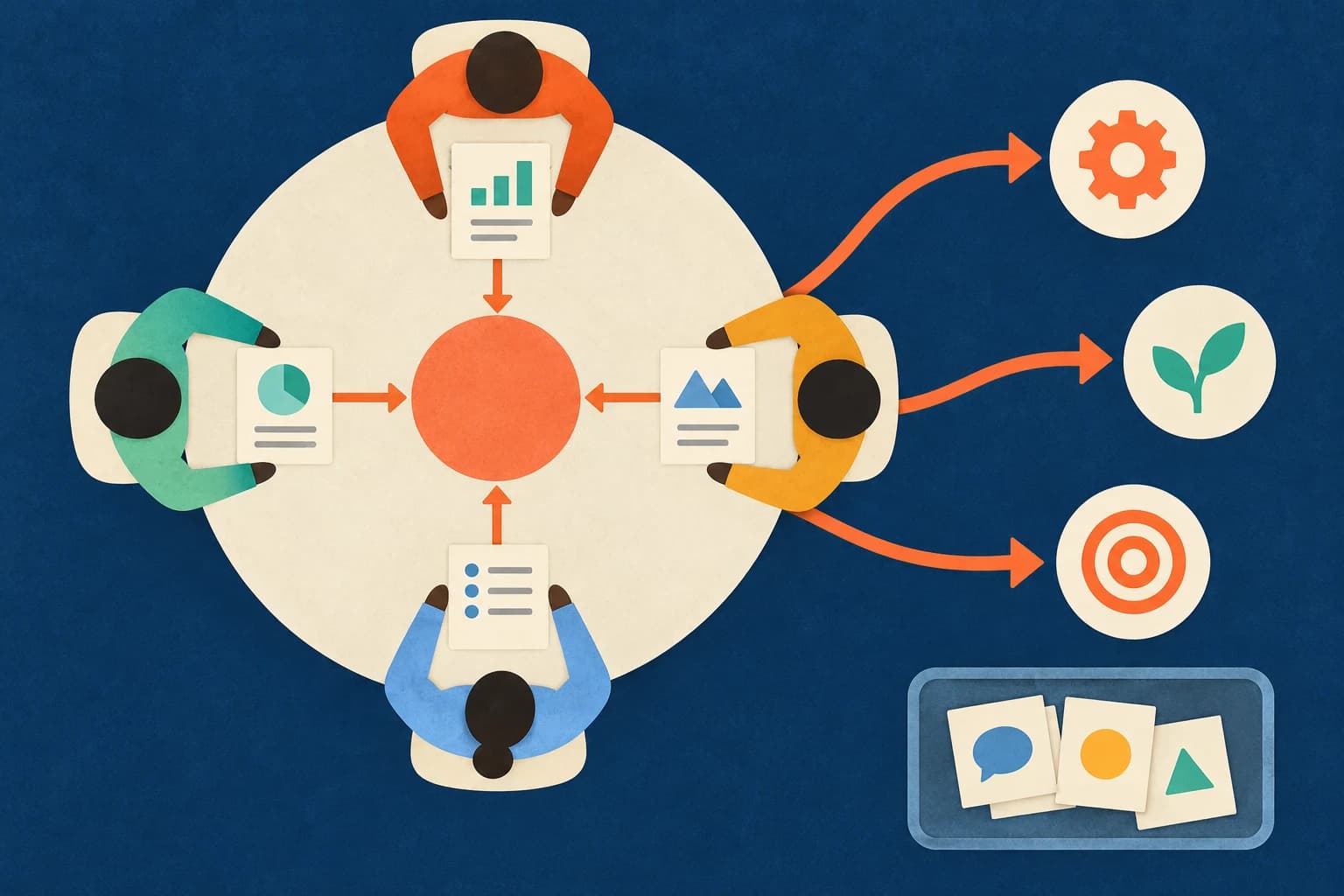
A facilitator can ask each pilot partner to write one benefit and one concern before the conversation begins. A support representative might flag the staffing cost of a broad launch; a researcher might point out that internal staff will not reproduce customer conditions. Invite both observations before ranking options. Make it safe to disagree with an idea while keeping the conversation respectful. The meeting map should make roles and sequence clear without turning participation into an inflexible script.
Handle disagreement and parked topics visibly
Disagreement can reveal that participants are weighing different outcomes. Ask which criterion drives each position and whether it is a fact, assumption, or preference. If the question needs evidence the group lacks, assign a small investigation with an owner and a return point. Keep a visible parking lot for related concerns that are outside the decision. A parking lot is useful only if someone decides later whether each item deserves work; otherwise it becomes a graveyard of ignored suggestions.
If operations favors a narrow pilot and sales favors a broad one, ask what each route teaches and what service load it creates. The group may find that a smaller customer pilot offers better learning than an internal-only test while limiting support exposure. If it cannot resolve the tradeoff, name the sponsor who will. Do not use consensus as a substitute for authority when the organization has a clear decision owner. Record dissent when it signals a material risk that should be revisited.
Capture decisions separately from discussion notes
A decision record should state what was chosen, who chose it, when it applies, and any conditions or review date. Action records need one owner, a deliverable, and a due point or trigger. Notes can preserve useful context, but they should not force absent colleagues to search paragraphs for the current commitment. State what remains undecided and who will resolve it. If the answer is a recommendation awaiting approval, label it accordingly rather than presenting it as final.
For the pilot, the record could say: “Begin with five existing customers who already use the workflow weekly; the product lead owns selection, support reviews readiness before invites, and the sponsor revisits scope after the first feedback cycle.” The number is an example to be set by the real team, not a universal prescription. Include assumptions and stop conditions. If the selection depends on consent or eligibility, show that constraint so no one turns a meeting sketch into permission to contact customers.
Check whether the meeting earned its time
Afterward, check whether the decision was understood and the actions started. If participants leave with different interpretations, update the record promptly and clarify with the decision owner. Notice whether the meeting repeatedly creates actions that no one has capacity to complete. That may signal that the agenda is too broad or the group lacks authority. Cancel or shorten recurring meetings when their purpose disappears; preserving a calendar slot is not evidence of value.
The facilitator can ask attendees what part of the structure helped and what delayed the choice. If the team repeatedly debates evidence that could have been circulated in advance, improve the pre-read. If a quiet role’s concern appears only after the meeting, change how input is collected. Adapt the agenda based on those observations. A strong working meeting feels purposeful because people understand the question, have room to contribute, and can see exactly what changed as a result of gathering.
Build the meeting route in Autodiagram: purpose, shared evidence, options, decision owner, and action record. Export the outline as a PNG for a pre-read, then keep formal commitments in the team record.


