Choose the moment the map begins
A flowchart gets easier to use when it answers one operational question. For a delayed order, ask: what should the support representative do next after a customer reports that a package has not arrived? That question excludes warehouse forecasting, refund policy design, and carrier performance analysis. Those subjects may matter elsewhere, but putting all of them here would blur the task at hand.
Set a start condition that two representatives would recognize in the same way. “Customer says late” is vague: the delivery estimate may have passed, or the package may simply be in transit. Begin when the representative has the order number and the promised delivery date. Put that condition in the opening node so the diagram does not appear to cover every shipping question.
Write the ordinary route first
Before adding branches, describe the most common case in plain steps: look up tracking; compare the last scan with the estimate; tell the customer the current status. Give each step an actor and an action. “Check tracking” is more useful than “Tracking,” because it describes work. Keep the action short enough to fit in a box without shrinking the type.
Now walk a sample order through the route. The tracking page says the parcel left the regional hub yesterday and still falls inside the delivery window. The representative can share that update and set a follow-up date. This is the happy path, but it should not consume the whole chart. The ordinary route establishes a baseline against which exceptions can be judged.
Branch only when the next action changes
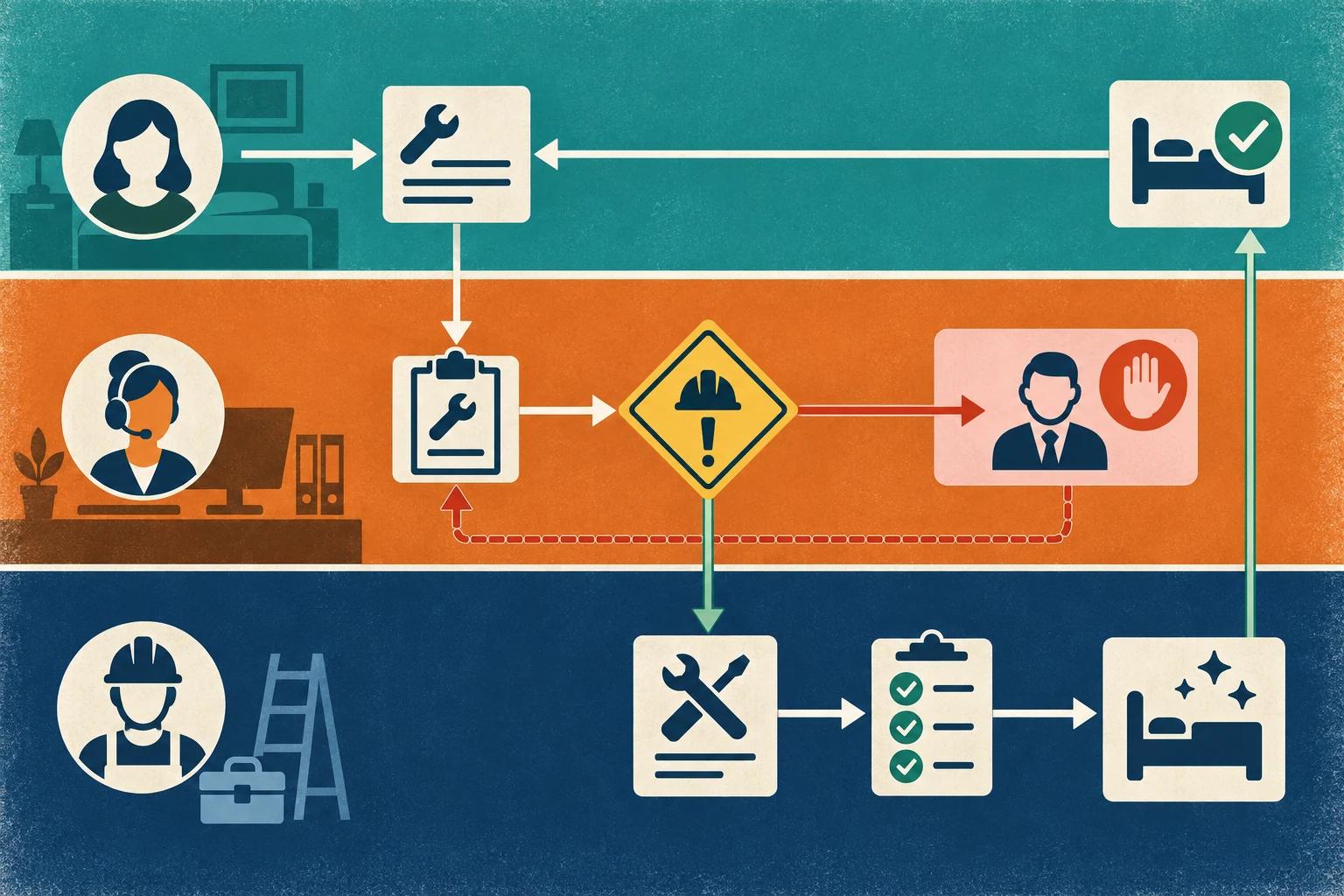
Add a decision after checking tracking: is the estimate already missed? A “no” branch returns to the status-and-follow-up action; a “yes” branch checks whether the carrier has recorded an exception. Phrase the diamond as a question and label both outgoing lines. A line labeled “yes” is only clear when its question remains visually close and unmistakable.
Suppose the carrier marks the parcel “address issue.” That result changes the next action: confirm the delivery address with the customer, then follow the carrier’s correction process. A stalled scan without an exception may instead call for a carrier inquiry. These are distinct branches because they assign different work. If two conditions lead to the same action, combine them and explain the shared rule in the node.
Give every branch a useful ending
A branch should end in a next action or a clear handoff, not an adjective such as “delayed” or “high priority.” In this example, useful endings include “send address correction,” “open carrier inquiry,” and “schedule customer update.” A representative should not have to infer whether an outcome means wait, refund, escalate, or close the conversation.
Decide what completion means. If the representative promises to update the customer tomorrow, the flow is not complete until that update is sent or reassigned. Draw a terminal step for recording the follow-up owner and date. This small detail prevents the chart from treating communication as an optional courtesy when it is actually part of resolving the report.
Keep policy and judgment separate
A map can show required policy checks, but it should not invent rules. If the refund threshold is unclear, mark “confirm refund policy” and ask the policy owner to resolve it before publication. Do not turn a representative’s usual habit into a rule merely because it makes the path neat. The chart must be verified against the actual service promise and carrier workflow.
Some cases still need judgment. A shipment containing a time-sensitive item may deserve escalation even when the standard delivery window has only just passed. Show where a supervisor can review that case, and identify who can make the decision. Avoid building a separate branch for every imaginable product; note the relevant exception criteria in a linked procedure if the chart becomes crowded.
Test the drawing with real cases
Trace three examples: an order still in transit within the estimate, a missed estimate with no new scan, and a package blocked by an address error. For each, start at the first node and follow the labels exactly. If you need to explain an unlabeled arrow or skip a decision, revise the diagram. A cold reader is more revealing than the person who drew it.
Finally, check that the exported diagram remains readable in its destination. A broad flowchart may need a left-to-right layout for a team screen or a stacked arrangement for a document. Autodiagram accepts a title and one idea per line, with indented lines for branches, and lets you adjust layout and visual style after the logic is settled. Keep a policy link beside the finished chart when rules change often.
To draft this in Autodiagram, enter “Delayed order support” as the title and put each action on its own line; indent the exception routes beneath the tracking decision. Choose a process layout, then edit branch labels so “estimate missed?” stays next to its yes and no paths. Adjust palette and type only after the route reads correctly, and export a PNG or SVG for the support guide.